Open each section to read the full curriculum outline for that key stage.
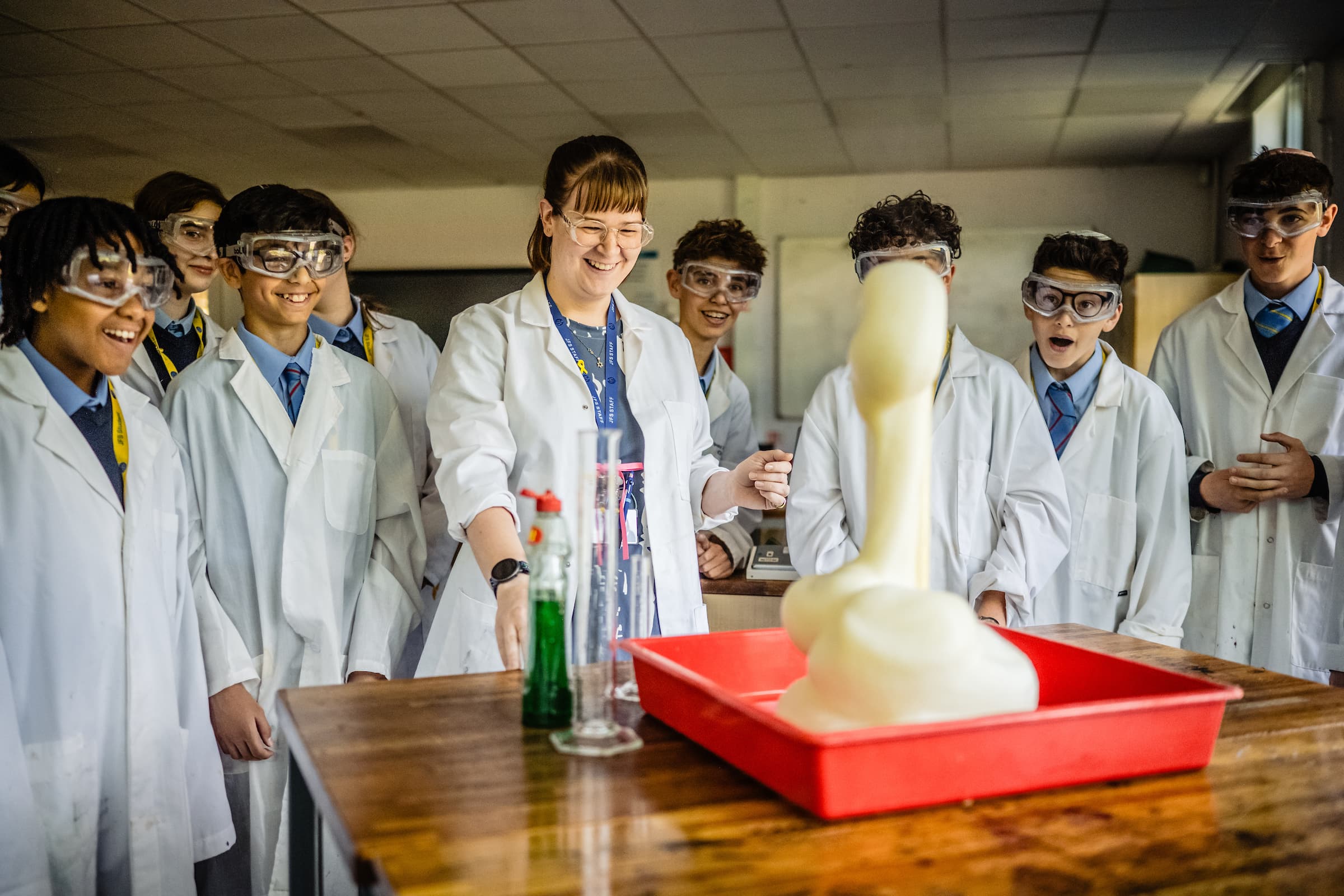
At Key Stage 3, our Science curriculum lays a strong foundation in Biology, Chemistry, and Physics through engaging, hands-on learning. Students develop critical thinking skills, scientific literacy, and a curiosity about the world around them. Pupils follow content according to the National Curriculum for science using a clear strand-based approach, which reviews and builds on the understanding from KS2. Practical skills are modelled for Pupils with opportunities for pupils to develop the skills of enquiry and working scientifically. During Key Stage 3 Pupils will also have the opportunity to participate in STEM activities and develop the understanding and implications of landfills and the importance of sustainability for the future of our planet. What is covered?
GCSE Biology GCSE Chemistry GCSE Physics GCSE Combined Science Syllabus numbers 1BI0, 1CH0 & 1PH0 1SC0 GCSE Certificates Awarded
Lessons per fortnight
Content 6 Units Bi/B1 and Bi/B2 Ch/C1 and Ch/C2 Ph/P1 and Ph/P2 6 Units Sc/B1, Sc/C1 and Sc/P1 Sc/B2, Sc/C2 and Sc/P2
A Level biology is a multidisciplinary subject that involves blending the practical and the theoretical in order to achieve a deeper understanding of how living organisms interact with each other, and their environments. The content is divided into six teaching modules and each module is further divided into key topics. The course will be taught by two specialist teachers, who will be teaching two different parts of the course at the same time. Module 1 – Development of practical skills in biology Module 2 – Foundations in biology Module 3 – Exchange and transport Module 4 – Biodiversity, evolution and disease Module 5 – Communication, homeostasis and energy Module 6 – Genetics, evolution and ecosystems.
The subject is informally split into three areas: Organic, Inorganic and Physical Chemistry. These are interwoven so that a variety of topics are taught throughout. There is an emphasis on practical work which is carried out on an individual basis wherever possible. Students will be given regular homework tasks which will involve research and sample examination questions amongst other written tasks. The theory of the course will complement the practical work and will seek to explain modern chemistry in contexts such as climate change, green chemistry, pharmaceuti- cals and chemical research.
Topic 1: ‘Working as a Physicist’ covering experimental methods and data analysis Topic 2: Mechanics - covering kinematics and dynamics of bodies Topic 3: Electric Circuits - covering DC electricity Topic 4: Materials – covering the structural properties of solids and liquids Topic 5: Waves and Particle Nature of Light – covering wave phenomena and quantum physics Topic 6: Further Mechanics – circular motion and momentum Topic 7: Electric and Magnetic Fields – Electrostatic forces, capacitors, magnetic force and induction Topic 8: Nuclear and Particle Physics- fundamental particles and colliders / detection Topic 9: Thermodynamics – specific heat capacity and gas laws Topic 10: Space – Stellar evolution, determining distances and cosmology Topic 11: Nuclear Radiation – Nuclear fission, fusion and decay Topic 12: Gravitational Fields – Newtonian gravity and gravitational potential Topic 13: Oscillations – simple harmonic motion